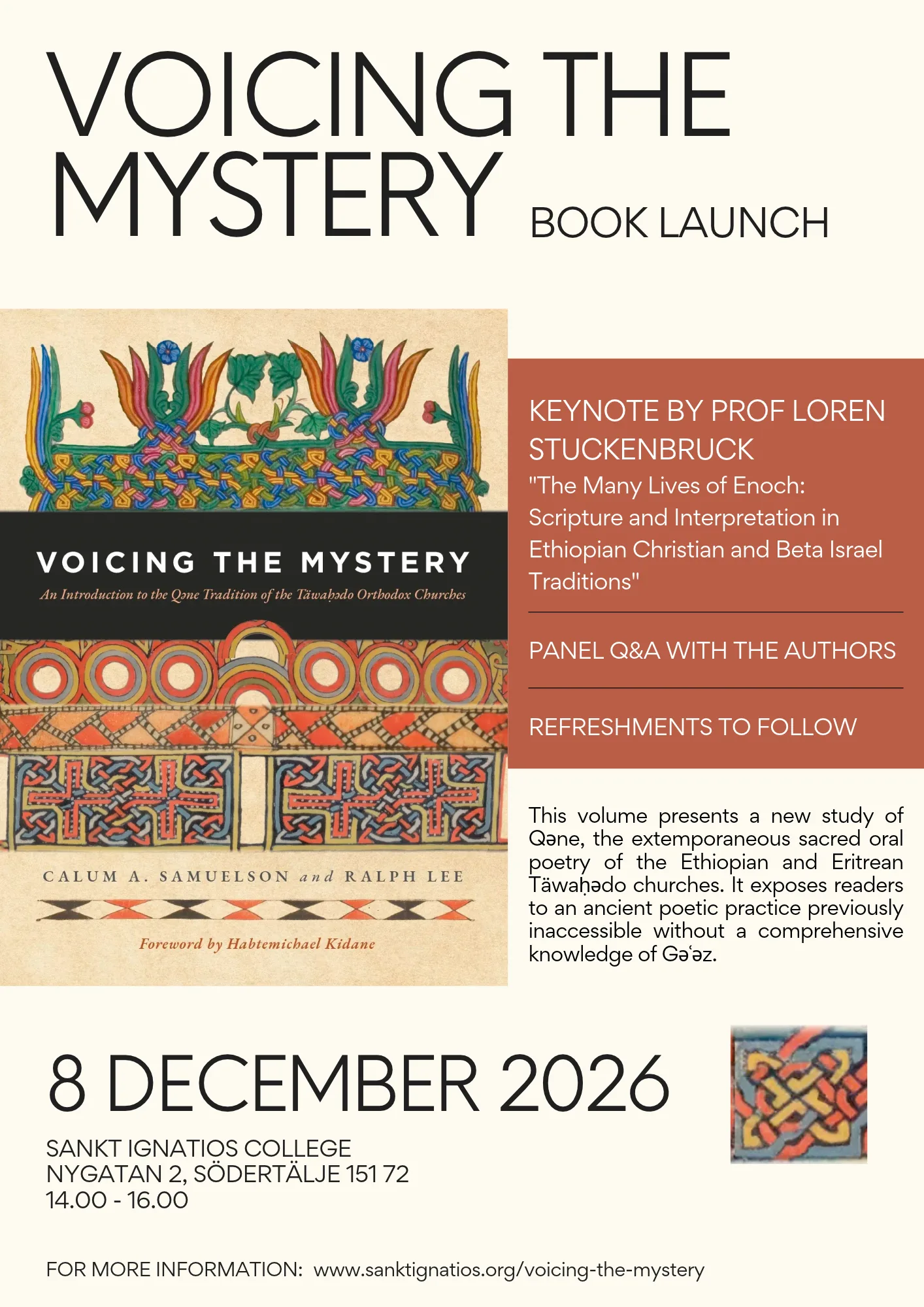
On 8 December 2026, St. Ignatius College will host Professor Loren Stuckenbruck and other scholars in the fields of Orthodox and Ethiopian studies for a book launch of Expressing the Mystery: An Introduction to the Qane Tradition of the Täwaḥǝdo Orthodox Churches. Written by Senior Lecturer Dr Ralph Lee and Postdoctoral Researcher Dr Calum Samuelson, Voicing the Mystery presents a new study of Qǝne, the impromptu sacred oral poetry of the Ethiopian and Eritrean Täwaḥǝdo churches. It exposes readers to an ancient poetic practice previously inaccessible without a comprehensive knowledge of Gǝʿǝz.
The book is generously provided as Open Access through Bridwell Press.
We invite you to join us for the book launch which will consist of a keynote lecture by Prof. Stuckenbruck, followed by a Q&A panel with the authors. The event will take place on December 8, 14:00-16:00 on the campus of Sankt Ignatios College in the lobby on the ground floor.
The description of the book is as follows:
This volume presents a new study of Qǝne, the extemporaneous sacred oral poetry of the Ethiopian and Eritrean Täwaḥǝdo churches. It discusses the technique of “Wax and Gold” used to compose Qǝne, through which poets construct multilayered meaning using complex grammatical structures, polysemous vocabulary, and oblique allusions to texts and customs. The Introduction outlines the history of the Qǝne tradition, its liturgical function, and the challenges involved in understanding its multiple layers of meaning, and it provides a detailed account of the translation method developed for this study.
Aimed at both scholars of the Täwaḥǝdo tradition and a wider audience, this book exposes readers to an ancient poetic practice previously inaccessible without a comprehensive knowledge of Gǝʿǝz. The book introduces the new approach of Integrative Translation: each poem is presented through paired Plain and Poetic translations, enabling readers to perceive the branching meanings of the original Gǝʿǝz text and the diverse connections they evoke. A selection of fifteen qǝne poems is included, drawn from published collections compiled by notable traditional scholars of the churches, each featuring the Gǝʿǝz text and paired translations on facing pages.
Extensive annotations guide readers through the interpretive world in which Qǝne is composed, tracing the scriptural, liturgical, exegetical, hagiographical, and cultural sources that shape the tradition and illuminate the multiple meanings embedded in each poem. A Glossary also explains key terms and concepts. This is the first volume to make the Qǝne tradition accessible in English while preserving the distinctive multilayered character of the poetry.