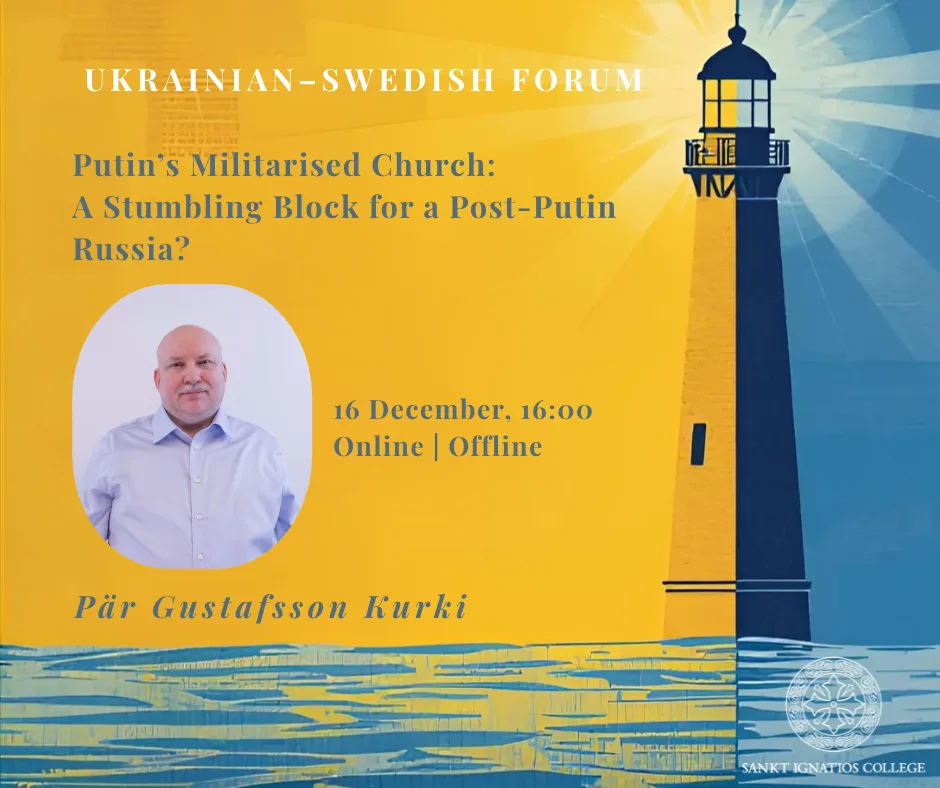
Ukrainian-Swedish Forum

Putin’s Militarised Church: A Stumbling Block for a Post-Putin Russia?

16 dec 2026 Nygatan 2

The Ukrainian-Swedish Forum invites you to a lecture followed by an open dialogue on the role of the Russian Orthodox Church in Russia’s militarisation and its potential implications for the country’s future.

In 2009, a presidential decision re-established the Institution of Military Clergy (Institut Voennogo Dukhovenstva) in Russia, 91 years after its abolition. Since then, military clergy have become an important part of the relationship between the Russian Orthodox Church, the military, and the Russian state.

The lecture will examine the Military Clergy as an institution, explore its theological underpinnings, and discuss how it serves as a vehicle for the Russian executive’s militaristic propaganda, providing pseudo-theological justifications for Russia’s wars of expansion among military personnel.

The final part of the lecture will consider a broader question: What role might the militarised Russian Orthodox Church and its military clergy play in a post-Putin Russia? Could they become an obstacle to political and social transformation?

The lecture will be followed by an open dialogue, offering participants an opportunity to reflect on the relationship between religion, political power, militarism, and Russia’s possible future.

Pär Gustafsson Kurki (MPhil, DPhil, 2008, Oxford University, United Kingdom) is a senior researcher at the Swedish Defence Research Agency, FOI. Pär has lived, worked and studied in Russia. In 2028, Historiska Media Förlag will publish his narrative non-fiction book about Russia’s path to war (in Swedish).

Date: 16 December, 4 pm CET

Format: Online and Offline in Södertälje.

To participate, please fill out the registration form. 

Ukrainian-Swedish Forum

From Displacement to Agency: The Ukrainian Diaspora as Actors in Ukraine’s Post-War Development

26 nov 2026 Nygatan 2, 151 72 Södertälje Avslutad

More than four million Ukrainians live under temporary protection in the EU, alongside a long-established diaspora and those who left after 2014. Debates about Ukraine’s recovery often see them either as recipients of aid or as a workforce that needs to return. This lecture treats Ukrainians abroad as actors in Ukraine’s recovery, who can help shape their country’s future whether they come back or stay abroad.

Drawing on SITE research on displaced Ukrainians in Sweden, a mapping of Ukrainian civil society organisations across the Nordic-Baltic region, and policy work on Ukraine’s recovery, the lecture asks what turns displacement into agency. It looks at four channels: advocacy and civic voice, skills, capital, and the transfer of institutional and European experience. It also shows how host-country policy can open or close these channels. Legal uncertainty and administrative barriers have often left people with rights on paper but few workable pathways.

The lecture also addresses the risks. Who speaks for the diaspora? And how can Ukraine welcome diaspora engagement and investment while protecting its institutions? It closes with implications for Ukraine, for host countries such as Sweden, and for the EU.

Anna Anisimova is a Researcher at the Stockholm Institute of Transition Economics (SITE) at the Stockholm School of Economics, where she has worked since 2020. Her research covers human capital, gender economics, and transition economies, with a focus on Ukraine’s recovery and the economic consequences of Russia’s war. She has written on the integration of displaced Ukrainians in Sweden, Ukrainian civil society across the Nordic-Baltic region, humanitarian demining, the gender dimension of reconstruction, Russia’s counter-sanctions, and hostile information threats. Her policy brief on displaced Ukrainians in Sweden was highlighted by the European Commission’s Directorate-General for Migration and Home Affairs.

Before joining SITE, she was an Assistant Professor at Donetsk National University, where she earned her PhD in Economics in 2010.

Date: 26 November, 3pm CET

Format: Offline, Online 

To participate, please fill out the registration form.


Ukrainian-Swedish Forum

Rebalancing Ukraine’s Complex Religious Landscape with Cyril Hovorun

3 jun 2026 Nygatan 2, 151 72 Södertälje Avslutad

This meeting continues a series of open discussions and practices within the Ukrainian-Swedish Forum. It is a platform, initiated by Sankt Ignatios College, for long-term dialogue and actions on Ukraine’s reconstruction and democratic post-war renewal, thereby building a shared Ukrainian-European horizon.

One of Ukraine’s defining characteristics is diversity. This applies to the country’s religious landscape as well. Various religious groups, including Muslim and Jewish, rub their shoulders without pushing each other. Diversity causes friction only when it comes to the Orthodox churches. They do not accept each other, to say the least, and thus destabilise the fragile internal balances within the country. The talk will explore the imbalances between the Ukrainian Orthodox churches and suggest ways to rebalance them.

Cyril Hovorun is a professor of Ecclesiology, International Relations and Ecumenism at Sankt Ignatios College. He is also the Director of the Huffington Ecumenical Institute at Loyola Marymount University in Los Angeles, California.

Date: 3 June, 16.00 CET

Format: Online and in person at Nygatan 2, Södertälje.

If you have any questions, please reach out to Yuliia Naidych.

You can watch the recorded event here.

Ukrainian-Swedish Forum

Transforming Conflicts: The Role of Civil Society Across Divides with Andy Carl

28 apr 2026 Nygatan 2, 151 72 Södertälje Avslutad

A talk followed by a group discussion given by Andy Carl, Advisor on Peace and Dialogue with the Swedish Fellowship for Reconciliation. This meeting continues a series of open discussions and practices within the Ukrainian-Swedish Forum. It is a platform, initiated by Sankt Ignatios College, for long-term dialogue and actions on Ukraine’s reconstruction and democratic post-war renewal, thereby building a shared Ukrainian-European horizon.

This session will be an opportunity to think broadly about what it means to do effective work with others to find pathways to end and transform violent conflicts at this moment of global change. The session offers a practical framing of this issue from the perspective of a practitioner who has worked particularly with civil society and non-state actors in diverse contexts around the globe. There will be a particular focus on playing supporting roles and outsider-insider relationships with a presentation on some of the key challenges and sharing comparative international examples of trying to meet them. A discussion will follow on the issues raised that are relevant for present and future efforts to address and ease tensions within Ukrainian society, including among different religious communities, and between Ukrainians at home and those living abroad. It will also consider how these insights might inform broader reflections on reducing violence and opening space for more sustainable and inclusive forms of peace.

Andy Carl is an experienced peacebuilding practitioner with a career of leadership in the international NGO/ civil society sector. He currently works as an independent consultant and advisor to groups, governments and organizations engaged in working on peace, justice and social change processes.  He is currently acting as an advisor to the Swedish Fellowship of Reconciliation on their work with Sahrawis from Western Sahara and more recently members of Ukrainian civil society working on dialogue and peace. He has other field experience from working in Fiji, Papua New Guinea, The Philippines, Sierra Leone, Liberia, Sri Lanka, and Uganda as well as leading an organisation (CR) that worked extensively in the South Caucasus.

Date: 28 April, 6pm CET

Format: Online and in person at Nygatan 2, 151 72 Södertälje.
If you have any questions, please reach out to Yuliia Naidych.
You can watch the recorded event here.

Ukrainian-Swedish Forum

The Kyivan Theological School and Modern Orthodox Theology with Danylo Leleko

14 apr 2026 Online Avslutad
This meeting continues a series of open discussions and practices within the Ukrainian-Swedish Forum. It is a platform, initiated by Sankt Ignatios College, for long-term dialogue and actions on Ukraine’s reconstruction and democratic post-war renewal, thereby building a shared Ukrainian-European horizon.
Orthodox theology of the early twenty-first century is undergoing a critical reassessment of the Neo-Patristic Synthesis — the paradigm that dominated Orthodox thought throughout the second half of the twentieth century. One of the most consequential legacies of this paradigm is a deeply biased view of the Kyivan theological tradition of the seventeenth and eighteenth centuries, which was portrayed as the primary source of the “Westernization” and “pseudomorphosis” of Orthodox theology.
Contemporary scholars have compellingly demonstrated that this judgment was driven not by theological reasoning, but by political and historiosophical motivations far removed from the actual content of the Kyivan school. This opens before us an urgent task: freed from these imposed prejudices, to rediscover and genuinely engage with the theological substance of the Kyivan tradition on its own terms.
This lecture proposes to take a first step in this direction — to examine the Kyivan school of the seventeenth and eighteenth centuries according to its own internal logic and to clarify its rightful place in the history of Orthodox theology.
Danylo Leleko is a philosopher, theologian, and translator of modern theological texts. He is currently a PhD student at Dragomanov Ukrainian State University. His research interests include Eastern Patristics, contemporary Orthodox theology, and philosophical theology.
Date: 14 April, 18.00 CET
Format: online
If you have any questions, please reach out to Yuliia Naidych.
You can watch the recorded event here.
Ukrainian-Swedish Forum

Russkiy Mir: The ”World” that Promised Peace

17 maj 2026 Nygatan 2, 151 72 Södertälje Avslutad
This meeting begins a series of open discussions and practices within the Ukrainian-Swedish Forum. It is a platform, initiated by Sankt Ignatios College, for long-term dialogue and actions on Ukraine’s reconstruction and democratic post-war renewal, thereby building a shared Ukrainian-European horizon.
This session examines Russkiy mir (“the Russian world”) as a modern ideology shaped by history and the influence of the Russian Orthodox Church. It explores how religion, culture, language, and politics were combined into a single worldview presenting Russia as a moral and civilizational power — and how this vision has been turned into a rationale for war and violations of basic human rights.
Rather than treating its link to war as simple nationalism, the discussion highlights deeper roots: Soviet ideas of nationhood, traditions of centralized authority, and the social dislocation after the Soviet collapse. These forces enabled a close church–state alliance and helped legitimize Russia’s war against Ukraine, with lasting consequences for Europe’s political future.
Our lecturer – Michael Hjälm- is the Dean of Sankt Ignatios College, Sankt Ignatios folkhögskola and the Unit of Religious Studies and Theology; Senior Lecturer and Subject Representative, Practical Theology with Religious Behavioral Science.
Date: 17 March (Tuesday), 18.00-19.30
Format: online and offline at Nygatan 2, 151 72 Södertälje.
If you have any questions, please reach out to Yuliia Naidych.
You can watch the recorded event here.